
The Beef Cut Sheet Guide: Every Cut in a Half Cow and How to Choose
By Beef Near Me ·
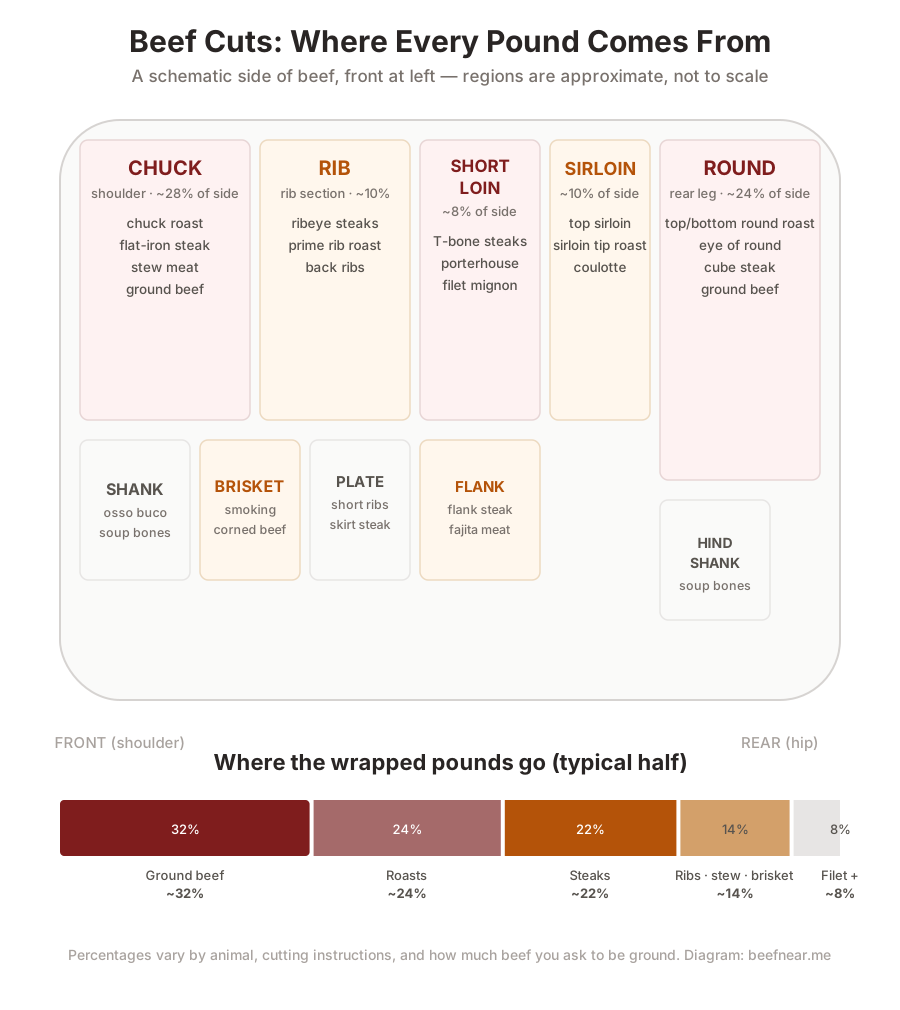
A half cow gives you ~185 lb across chuck, rib, loin, sirloin, and round: roughly 32% ground, 24% roasts, 22% steaks. This guide walks the cut sheet line by line — steak thickness, roast sizes, and the choices first-timers get wrong.
The cut sheet is the order form you fill out at the processor telling them how to cut your animal: which muscles become steaks vs. roasts vs. ground, how thick, how packaged. Get it right and your half cow becomes a year of exactly the meals you cook; get it wrong and you're eating your mistake for months. This guide walks every choice, section by section.
What Are the Primal Cuts?
A side of beef divides into chuck (shoulder — roasts, stew, flat-iron), rib (ribeyes, prime rib), short loin (T-bones, porterhouse, filet), sirloin (top sirloin, sirloin tip), round (lean roasts, cube steak, ground), plus brisket, plate, flank, and shanks. Roughly a third of your wrapped weight is ground beef no matter what you choose — that's the trim and the less-tender muscle doing its job.
How Thick Should Steaks Be Cut?
1 inch is the default and the safest choice for strip, ribeye, and sirloin; 1.25–1.5 inches if you like a rare-to-medium-rare center and reverse-searing. Under an inch and you can't sear without overcooking the middle. T-bones and porterhouses typically run 1–1.5 inches because the bone adds thickness. Filets are usually cut thicker (1.5–2 inches) since the muscle is narrow.
What Roast Sizes Should I Order?
Match roast size to your household: 2–3 lb for two people with leftovers, 3–5 lb for a family. The chuck and round yield a fixed number of roasts; the processor can also cut large ones in half. Say "tied and netted" for rib roasts if you want them oven-ready, and specify bone-in vs. boneless — bone-in chuck and round roasts carry more flavor; boneless is easier to portion and freeze flat.
How Much Should Become Ground Beef?
You don't fully control this — trim dictates a floor of roughly 30% — but you control the extras. Common choices: ground from the whole chuck or round (leaner, more total ground), or keep those as roasts and accept the standard amount. Specify lean percentage if offered (85/15 is the all-purpose default) and package size — 1 lb is standard, 1.5–2 lb suits families. Ask for ten-pound "chubs" only if you'll repackage them; they don't fit toaster-oven meals.
What the Heck Do I Do with Brisket, Short Ribs, and Soup Bones?
- Brisket: one of the best smoking cuts that exists. If you don't smoke, ask for it corned or ground.
- Short ribs: braise them — they're the flavor jackpot of the plate section.
- Soup bones (shank sections): osso buco, stock, and marrow. Free flavor; say yes unless you genuinely won't use them.
- Organ meat (liver, heart, tongue, oxtail): usually optional — include what you'll actually eat.
What Choices Do First-Timers Get Wrong?
- Ordering all steaks, no roasts — the animal gives what it gives; converting roasts to "stew meat" just makes expensive stew.
- Too-thin steaks (¾ inch) out of caution. One inch, always.
- Skipping the "how many per package" question — you want packages matched to one family meal, not four.
- Forgetting to ask about fat trim — you can request ground beef blended with more or less fat, and suet for cooking.
Sample Cut Sheet for a Half
A balanced starting point for a family of four: ribeyes and strips at 1 inch, 2 per package; T-bones 1.25 inch; filets 1.5 inch, 2 per package; chuck roasts 3 lb bone-in; round roasts 3 lb; brisket whole; short ribs cut 2–3 inch; ground 85/15 in 1.5 lb packages; stew in 1.5 lb bags; soup bones in 3 lb bags.
Before you fill one out for real, read what to ask the rancher — which processor you'll use and their cut-and-wrap fee shape the whole order. To get to a cut sheet in the first place, find a rancher on our state directory and see whether a half is worth it for your family.